The story of the Rich Young Ruler confronts not our immorality, but our misplaced loves. Eternal life is not achieved by performance but received as gift; and the call of Christ is not first to lose everything, but to love Him above everything.
A Man We Would Admire
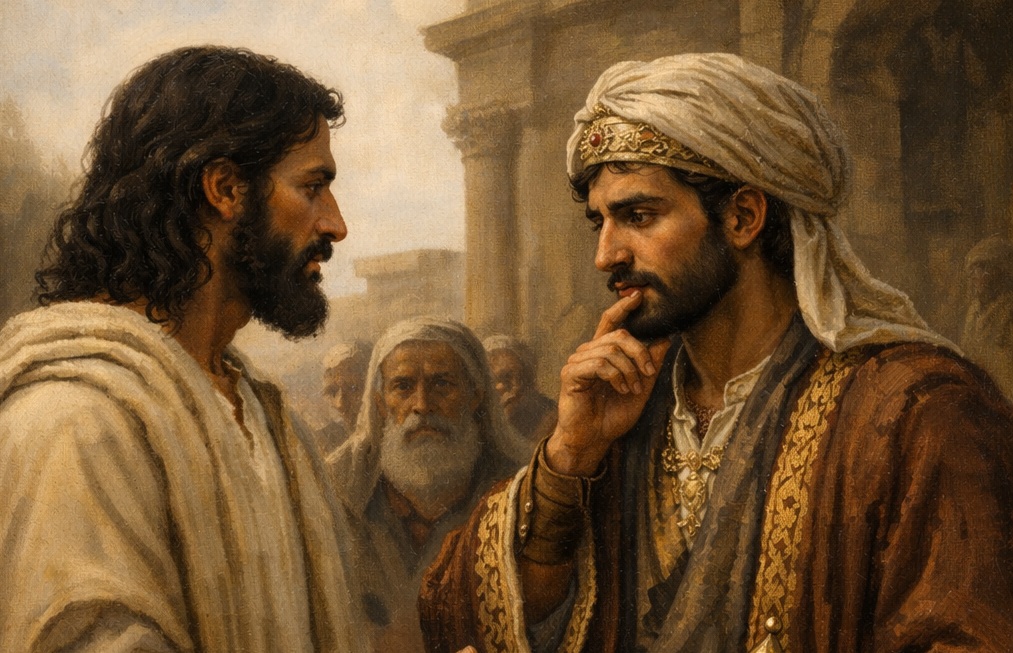
The account appears in Gospel of Matthew 19:16–22, Gospel of Mark 10:17–22, and Gospel of Luke 18:18–23. The man who approaches Jesus is described as rich, a ruler, and morally serious. In other words, he is precisely the sort of person we might place on a church leadership rota.
He runs to Jesus and asks:
“Teacher, what good deed must I do to have eternal life?” (Matt. 19:16)
Notice the verb: do.
He is not hostile. He is not flippant. He is earnest. He has kept the commandments from his youth, which is no small claim. He honours his parents. He has not committed adultery or murder. He has played by the rules. If we are honest, many of us see ourselves in him. I know I do.
I have tried to be responsible. To be disciplined. To build wisely. To live uprightly. And yet beneath all that good order, there can linger a quiet question:
“What must I do?”
As if eternal life were the final summit of self-improvement.
The Irony of Inheritance
Jesus replies in a way that exposes a subtle irony. The man asks what he must do to inherit eternal life. But inheritance is not earned. It is received. An inheritance flows not from performance but from relationship. It is given because one belongs. The ruler had been conditioned, as many of us have, to achieve. Tell me the steps. Tell me the sacrifice. Tell me the price. And Jesus, in love, puts His finger on the one place the man cannot surrender:
“If you would be perfect, go, sell what you possess and give to the poor… and come, follow me.” (Matt. 19:21)
We must be careful here. Jesus is not issuing a universal command that every believer must divest all assets. The early church included wealthy patrons (Acts 16; Rom. 16). Nor is this a parable about financial optimisation. It is a revelation of the heart. Mark tells us something profoundly tender:
“And Jesus, looking at him, loved him.” (Mark 10:21)
The demand flows from love.
The One Thing
The issue is not that the young man possesses wealth. It is that wealth possesses him. Jesus does not merely ask him to give up “everything.” He asks him to surrender the one thing he loves more than Him. The commandments he has kept externally now converge inwardly on the first commandment:
“You shall have no other gods before me.” (Ex. 20:3)
This is why the story unsettles us. It is not primarily about money. It is about rival affections. For one person, it may be status. For another, security. For another, theological certainty. For yet another, ministry success. For each of us, there is often a “one thing.” And when Jesus names it, we feel the tremor.
From Doing to Being
What I have always found most challenging about this encounter is that the ruler is so like me. Responsible. Moral. Faithful. Prepared. Yet still asking:
“What must I do?”
Jesus does not hand him a spiritual checklist. He offers Himself:
“Come, follow me.”
Eternal life is not a technique. It is participation in the life of God through Christ. It is gift, received by faith:
“For by grace you have been saved through faith… it is the gift of God, not a result of works.” (Eph. 2:8–9)
Faith in the One who died and rose again. Faith that His cross has accomplished what our performance never could. And from that faith flows love, compelling us to serve, to give, to obey, not to earn life, but because we have received it. The ruler goes away sorrowful, “for he had great possessions.” The tragedy is not that he is asked to lose wealth. It is that he walks away from Christ.
Loving Christ, Loving His Church
If this story exposes our misplaced loves, it also redirects them. For me, that redirection has taken a particular shape in my relationship with the Anglican Church across Africa. While I sit in the relative stability of the West, I am acutely aware that brothers and sisters across Africa face pressures many of us scarcely comprehend.
In some regions, there are tensions born of rapid religious change, including the growth of forms of Islam that place real social and political strain upon Christian communities. In others, the prosperity gospel promises wealth without the cross, subtly reshaping the gospel into something transactional, precisely the kind of performance-based faith the rich ruler exemplifies. How then might we love well?
1. We Pray. Prayer is not the least we can do; it is the most foundational. We pray for endurance under pressure. We pray for clarity in preaching Christ crucified. We pray for protection from distortion.
We pray for depth of discipleship. In doing so, we resist the illusion that the Church advances by our strength.
2. We Advocate. We tell their stories. We raise awareness in our congregations. We refuse to let geographical distance become emotional indifference. Love listens, and love speaks on behalf of others.
3. We Give. Generosity, when Spirit-led, becomes a tangible expression of solidarity. We do not give as benefactors rescuing the needy; we give as family supporting family. It is not us blessing them, it is God blessing us with the opportunity to use the resources He has given us for use across His wider Kingdom.
4. Some May Go. For a few, the call may be to build relationships in person, to learn, to serve, to partner. Not as saviours, but as fellow disciples. Each of us may be compelled differently. The question is not whether we replicate someone else’s obedience, but whether we surrender our own “one thing.”
The Question That Remains
The rich young ruler came asking, “What must I do?”
Jesus answered with a relationship: “Follow me.”
That invitation still stands.
It may require us to loosen our grip on something dear. It will certainly require trust. But what we relinquish pales beside what we receive: the life of the Son of God, shared with us by grace.
Perhaps the deeper question is not, “What must I do?”
But rather, “Whom do I love?”
And in loving Him, truly loving Him, we discover that eternal life was never a wage to be earned, but a gift already offered.
The call is not to optimise our assets. It is to yield our hearts. And that, though costly, is freedom.