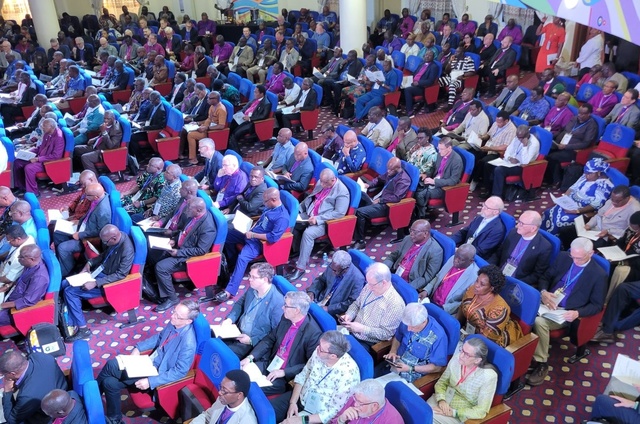
Writing on the morning of Thursday 5 March, the GAFCON G26 gathering in Abuja now appears to be approaching its decisive moment.
The opening day of the conference felt like a declaration that something historic was underway, and the second day felt more like the careful laying of foundations. Wednesday 4 March was less about dramatic announcements and more about working through the theological and structural logic behind what may soon emerge.
Behind closed doors last night the GAFCON Global Council met at St Matthias House in Abuja, the headquarters of the Church of Nigeria. Their task was to elect an archbishop who will serve as primus inter pares, first among equals, among the primates aligned with the movement. The result is expected to be announced later today. However the deeper significance of Day Two was not simply the vote itself. It was the argument being built around it.
Scripture and boundaries
The theological tone of the day continued themes already heard during the opening service. In the morning session Bishop Emmanuel Egbunu preached from the book of Joshua and returned repeatedly to the theme of boundaries. In the biblical narrative boundaries are not merely geographical markers but signs of faithfulness to the covenant. In the same way, he suggested, the church must remain within the boundaries established by Scripture.
This emphasis on biblical authority appeared again and again throughout the day’s teaching sessions. One of the conference presenters, Bishop Alfred Olwa of Uganda, argued that the heart of Anglican unity must be the Word of God rather than institutional arrangements.
“The Bible is the foundation of the communion,” he said. “If the church sidelines the Bible it will lose direction.”
Similarly Bishop Flavio Adair of Brazil questioned whether the traditional “Instruments of Communion” centred on Canterbury have been able to preserve genuine unity.
“Communion is not made by structures,” he suggested. “Communion is unity in the same faith.”
For Bishop David Anoha of Nigeria the present moment represented something more positive than simply protest. At one point he drew applause from the hall with the line that the emerging global Anglican structures would allow Anglicans “to worship God as he deserves and not as men desire.”
Taken together these contributions reveal something important about the mindset of many participants. For them this gathering is not primarily about institutional rearrangement but about what they see as the defence of the historic Christian faith.
The leadership question
The structural centrepiece of the conference is the election of a primus inter pares. Conference leaders have been careful to stress that this position is not intended to function as an Anglican equivalent of a pope. Provinces will remain autonomous and doctrinal authority will continue to rest in Scripture and the historic formularies of Anglicanism rather than in a central office.
Nevertheless the symbolism is unmistakable. For centuries the Archbishop of Canterbury functioned as the recognised focal point of Anglican unity. The election of another figure to play a similar coordinating role signals that many within GAFCON no longer believe Canterbury can fulfil that function.
Several archbishops present at the conference were understood to be eligible for the role. Among those attending the gathering are
Henry Ndukuba of Nigeria
Stephen Samuel Kaziimba Mugalu of Uganda
Laurent Mbanda of Rwanda
Miguel Uchoa of Brazil
Siegfried Ngubane of REACH South Africa
the Primate of Chile
Several other primates associated with the GAFCON network were not present in Abuja. These include
Georges Ande of the Democratic Republic of Congo
Justin Badi Arama of South Sudan
Stephen Myint Oo of Myanmar
Jackson Ole Sapit of Kenya
How widely the eventual decision will be recognised across the broader Anglican world remains an open question.
A global gathering
Listening to conversations around the conference it is difficult not to be impressed by the organisational achievement involved in bringing together such a large and geographically diverse group of Anglican leaders.
Around 350 bishops and more than one hundred clergy and lay leaders have travelled to Abuja from across Africa, Asia, the Americas and beyond. The scale of the gathering itself reflects an important reality. The centre of gravity of Anglicanism has shifted decisively toward the Global South. Churches in Africa and parts of Asia are growing rapidly and many of their leaders understandably want a greater voice in shaping the future of the Communion.
Some speakers framed this explicitly in post colonial terms. The historic structures of Anglicanism, they argued, were developed in a world where the Church of England occupied a central position. Today the demographic reality is very different.
There is some force in that argument. Anglicanism has long been grateful for the missionary efforts that carried the gospel through Anglican forms of worship and theology across the globe. At the same time it is not unreasonable for churches that now represent the majority of practising Anglicans to ask whether leadership should reflect present realities rather than historical patterns.
Mission at the centre
Another important theme emerging from the discussions is the missionary emphasis that lies behind much of the movement’s thinking.
Bishop Julian Dobbs, acting archbishop of the Anglican Church in North America, spoke about the importance of maintaining the “inheritance of faith” received through the Reformation and passing it on to the next generation. He also stressed that the ultimate goal is the proclamation of the gospel.
“We have received a gospel once for all entrusted to the saints,” he said. “The structures we put in place must help us proclaim Christ faithfully to the nations.”
This perspective is echoed in some of the structural innovations being discussed. One example is the recognition of what conference organisers call “primates in formation”. These are leaders of emerging Anglican jurisdictions, including ministries serving Muslim background believers meeting in small house churches across Africa, the Middle East and Asia.
Even those who are cautious about the broader political implications of GAFCON may still recognise something admirable in this missional focus.
Voices from England
Developments in Abuja are also being followed closely by Anglican leaders in England. The Rev Vaughan Roberts from St Ebbe’s Church in Oxford reflected on the situation within the Church of England during an interview recorded at the conference. He suggested that the tensions now visible across the Anglican Communion have been building for many years.
“What we have within the Anglican Communion,” he said, “are two understandings of Scripture, two gospels, two paths.”
Roberts pointed particularly to the Living in Love and Faith process and the ongoing debate within the Church of England about the blessing of same sex unions. While recent procedural developments have slowed further changes, he suggested that many conservative Anglicans remain concerned about the long term direction of travel.
Perhaps his most striking comment concerned how the events in Abuja might be received in England itself. When asked how the Church of England might react to the creation of new global leadership structures, Roberts suggested that many people might barely notice.
For churches across Africa and parts of the Global South the debates in Abuja feel momentous. In England the significance may take longer to register.
A note of admiration and concern
Watching these developments unfold from a distance, I find myself holding two reactions at the same time. On the one hand, it is difficult not to admire the clarity, conviction, and organisational energy with which GAFCON has brought together such a large global gathering. The seriousness with which many participants approach Scripture and mission is genuinely encouraging.
On the other hand, I cannot help feeling a measure of disappointment that the relationship between GAFCON and the Global South Fellowship of Anglican Churches appears to have fractured. The GSFA had seemed to offer a pathway for reform from within the existing structures of the Communion. It sought to address many of the same theological concerns while still working inside the global Anglican family. The present moment feels as though that possibility has slipped away, at least for now.
There is also a deeper dynamic that deserves honest reflection. Many speeches here speak about Scripture, faithfulness and freedom from colonial structures. These are serious and important themes. Yet at times some of the rhetoric carries another tone as well.
Language about apostasy and about others abandoning the gospel can sound heavy handed. At moments the underlying message can feel less like an invitation to renewal and more like a declaration that “we know best, you are wrong”.
Power dynamics are rarely absent from church conflicts. It would be naïve to imagine that they play no role here. There may well have been ways to address some of these disputes more slowly and patiently over time. The question now is whether the path chosen will ultimately strengthen Anglican unity or deepen existing fractures.
Waiting for the announcement
For now the conference waits. By the time this article is read the primates may already have chosen the archbishop who will serve as the new primus inter pares. Whatever name emerges will carry considerable symbolic weight.
Yet beyond the immediate headlines a deeper question remains. Can the Anglican Communion still find a way to hold together a global family marked by deep theological disagreement, cultural difference and shifting historical realities?
Or are we witnessing the gradual emergence of new centres of Anglican life that will reshape the Communion in ways few imagined even a generation ago? For those who care about the future of the Anglican world, the wisest response may still be the simplest.
Pray for wisdom.
Pray for humility.
Pray for unity in truth.
And pray that in the midst of all these debates the church does not lose sight of its central calling to proclaim Christ to the world.